Can I Get My First Aid Certificate Online? Understanding How First Aid Courses are Run
Taking that first step toward getting certified in First Aid is an incredible decision. Many of us are looking for convenient, modern ways to learn new skills, which often leads to the question: Can I complete my entire First Aid Training online in Canada?
We want to help you understand the options, especially the flexible 'blended learning' path, and what it truly takes to earn a recognized Canadian Red Cross certification. It's about finding accessible programming that still gives you the genuine skills and confidence you need to step in when someone is relying on you.
What is a First Aid Certificate?
A First Aid certificate, like those issued by the Canadian Red Cross, is your official proof to validate that you have the knowledge and hands-on skills to respond to sudden injury or illness.
It confirms you have successfully completed an evidence-based training course and demonstrated the knowledge and hands-on skills required to respond to injury or sudden illness until emergency medical responder services arrive.
There are a variety of different first aid training courses available, depending on your required skill level, occupation, age, and various other factors.
Get certified with the highest standard. Find the right Red Cross course for your needs now!
What are the Benefits of Getting a First Aid Certificate?
Getting certified is a powerful choice that benefits you, your loved ones, and your community. It’s an investment in your ability to take meaningful action when it truly counts.
You gain the confidence to act in emergencies: First Aid Training teaches you the vital emergency steps and the confidence to perform essential techniques like CPR or proper wound management. This clarity and confidence are the most valuable tools you will carry into an emergency.
It’s a valuable asset for your career. Many roles require certification, ranging from First Aid Attendants in a workplace to healthcare professionals needing BLS for Healthcare. Demonstrating initiative by having a valid certificate is a meaningful way to show your commitment to safety.
You learn critical, specialized skills. Courses go beyond the basics, covering things like recognizing a heart attack, managing muscle injuries, and even responding to a mental health emergency or opioid emergency. This breadth of knowledge makes your skills relevant in a wide variety of scenarios.
Invest in yourself today. Our first-aid training offers practical value for your life and career.
Can I Get My First Aid Certificate Online in Canada?
Whilst there are online first aid courses available in Canada, for a full, certified First Aid course recognized for workplace or legal requirements, fully online classes & training alone are not enough. However, you can complete the knowledge component online through convenient and intuitive interactive modules; the core principles of emergency care require some hands-on, practical engagement.
This is why Training Partner organizations like BraveHeart focus on a "blended learning" model. This approach makes classes more accessible by letting you complete the theoretical portion at your own pace, but you must still attend a skills session day to demonstrate your physical CPR course skills and other practical competencies to a certified instructor. Upon successful completion, you will receive your download certificate electronically from the Canadian Red Cross.
Why In-Person Elements Are Important for a First Aid Course
While online learning offers convenience, developing real First Aid skills requires physical practice. The in-person component is vital because you must physically demonstrate techniques under expert guidance to earn a valid certification.
First Aid Trainees Choose In-Person Course For:
Practicing Physical Skills and Techniques
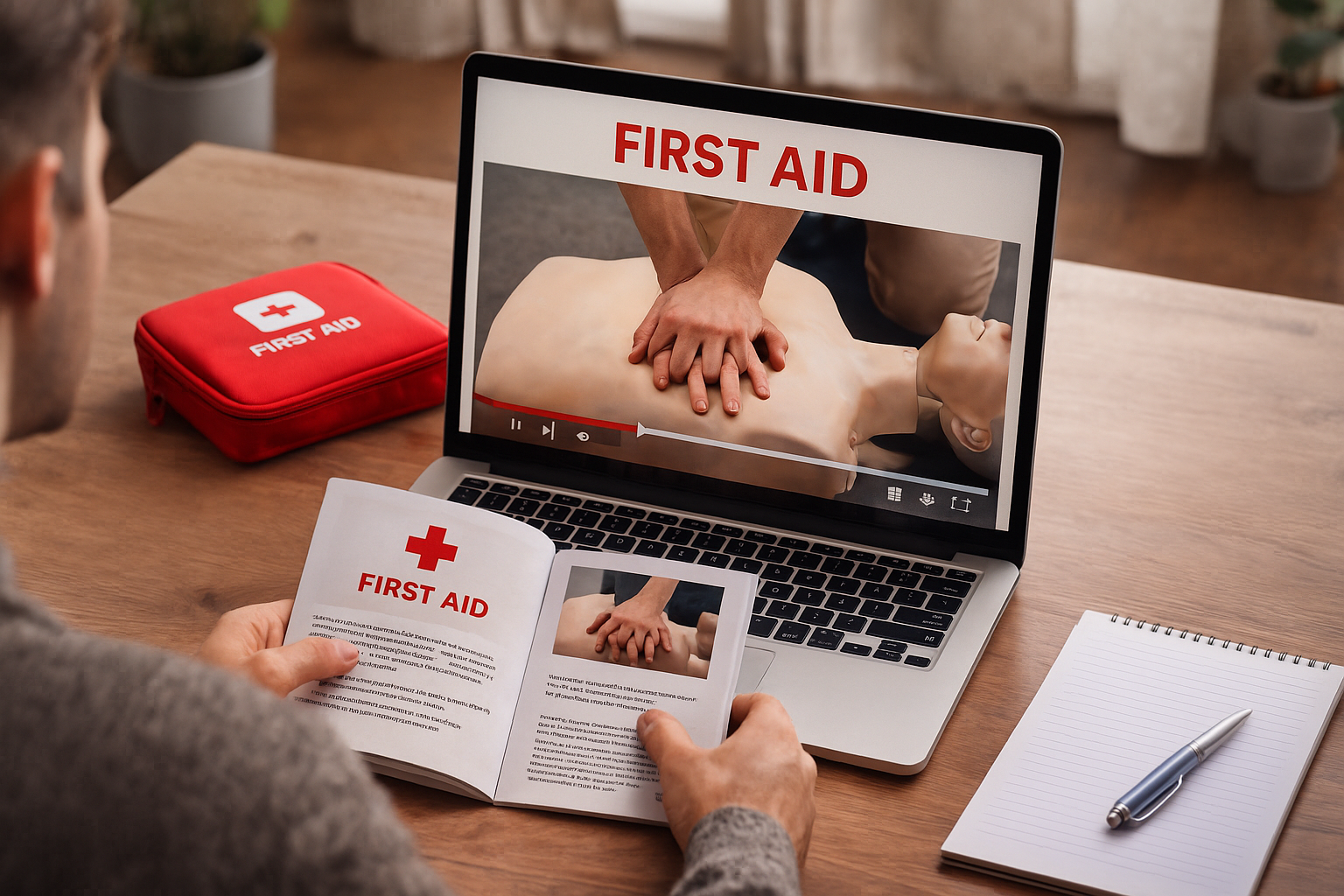
Performing high-quality chest compressions for CPR Training and using an AED requires physical effort and correct technique. Practicing on mannequins under the guidance of an expert ensures you meet the strict resuscitation education standards and can perform the skills effectively in a real-life situation.
Hands-on Assessment and Feedback
An experienced instructor must observe you performing crucial skills, such as controlling serious bleeding, properly rolling someone into the recovery position, or conducting a secondary assessment. This immediate, in-person feedback is essential for correcting errors and ensuring you are competent.
Developing Muscle Memory through Simulation Learning
It’s not enough to know the steps; you need the actions to feel natural under pressure. Simulation learning in a classroom environment, where you work through realistic scenarios, helps build the muscle memory needed for scene safety and effective intervention when you need to think quickly and clearly.
Build true confidence through realistic scenarios. Secure your spot in an upcoming class immediately!
What to Expect From a First Aid Course
When you decide to pursue your certification, the process is designed to be simple and focused on getting you the skills you need. At BraveHeart, we make it as seamless as possible to book, attend, and achieve your first aid training certification.
Step 1: Online Registration
The first step is using the simple, intuitive online registration system. You start by selecting the course name and class type you need, whether it’s a new certification, a recertification, or a blended format. You'll choose your preferred date and time and fill in your details, including any additional information needed.
Step 2: Course Attendance and Learning
Depending on the course you chose, you will either begin the online portion of your blended course or head straight to the classroom. Course duration varies significantly based on your needs.
Here are some of the popular CPR AED & First Aid Courses you can choose from, and what you can expect to learn:
Basic First Aid (Emergency First Aid): A one-day course covering the essentials of CPR Training and managing life-threatening emergencies such as severe bleeding, choking, and sudden illness.
Intermediate First Aid (Standard First Aid): A comprehensive two-day course (or blended equivalent) that builds on the basic level, covering a wider range of injuries and illnesses, including head, neck, and spinal injuries, environmental emergencies, and detailed Wound Management. This is often required for general occupational first aid.
Basic Life Support (BLS): A dedicated program focusing on high-performance CPR, emphasizing team response and advanced resuscitation techniques for healthcare professionals and First responders.
CPR/AED Training: A shorter course focused purely on Cardiopulmonary Resuscitation and the use of an Automated External Defibrillator.
Marine Basic First Aid: This course is tailored to the marine environment, addressing injuries and illnesses that might occur far from shore, including a focus on the unique challenges of water safety.
Mental Health First Aid: A specialized course teaching you how to recognize and provide initial help to someone experiencing a mental health emergency.
Youth First Aid & Babysitter First Aid: Courses designed for younger individuals to equip them with basic emergency response skills, injury prevention, and child care safety.
Step 3: Certification
Once you have successfully attended all required hours, demonstrated proficiency in the practical skills, and passed the knowledge evaluation, your Canadian Red Cross certification is processed.
The certification is recognized across the country and is typically valid for three years (1 year for BLS). You will be able to access your certificate instantly online—no need to wait for the mail!
Get Your First Aid Certification Seamlessly with BraveHeart First Aid
At BraveHeart, we offer various Canadian Red Cross First Aid certifications. We've built our program around flexible, accessible programming designed to give you the essential skills you need, whether you choose a fully in-person or a blended course format. Our goal is simple: to help you confidently achieve your required certification.